Review: Expanding Binomials with the Box Method
Before we dive into factorizing polynomials, let's quickly review how to expand two binomials using the box method. Remember, this method helps us multiply expressions like in a structured way. We set up a grid, and then multiply the terms from each binomial to fill in the boxes. The sum of the terms in the boxes gives us the expanded polynomial.
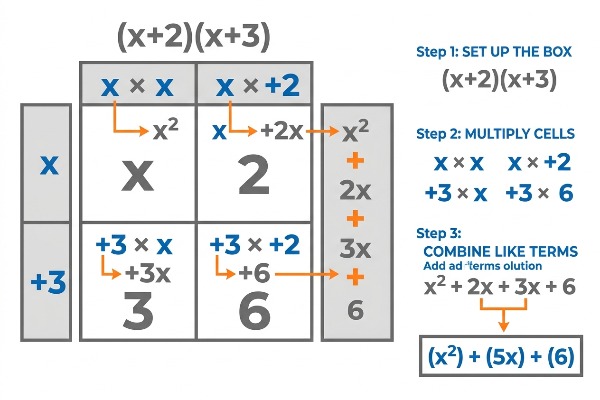
Let's factorize the quadratic polynomial using the reverse box method.
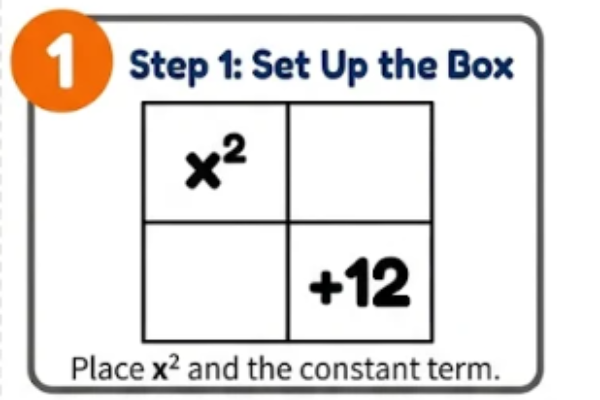
Step 1: Set Up the Box
Draw a 2x2 grid. Place the term in the top-left box and the constant term, , in the bottom-right box.
Step 2: Find the Product of the Remaining Terms
Multiply the coefficient of (which is 1) by the constant term (12). This gives us:
Now, find two numbers that multiply to 12 and add up to the coefficient of the middle term, . These numbers are 3 and 4, since
and:
These will be our terms for the remaining boxes.

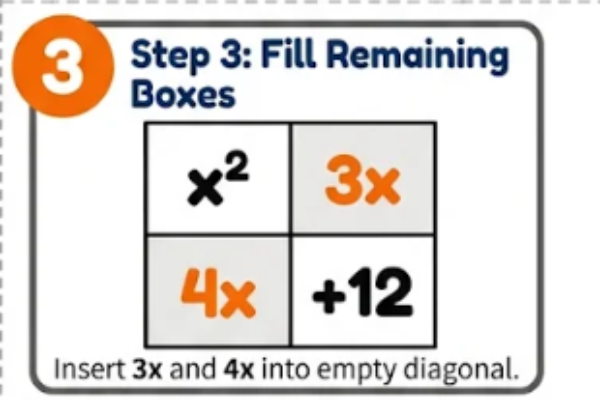
Step 3: Fill the Remaining Boxes
Place the two numbers you found (3 and 4) along with an in the remaining two boxes. So, we'll have and .
Step 4: Find the Greatest Common Factors (GCF) of Each Row and Column
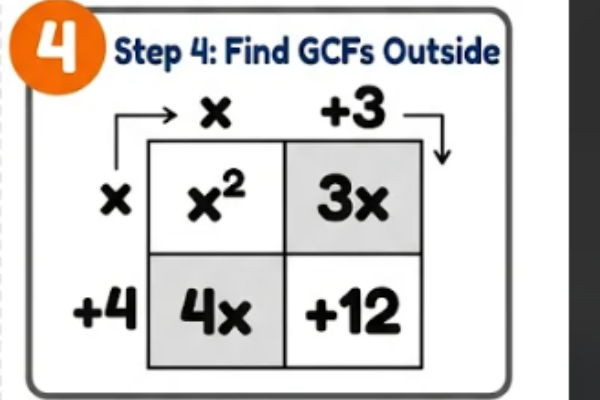
Look at each row and each column. Find the greatest common factor (GCF) for the terms in that row or column. These GCFs will form your binomial factors. For example, in the top row, the GCF of and is . In the bottom row, the GCF of and is . For the left column, the GCF of and is . For the right column, the GCF of and is .
Step 5: Write the Factors
Once you have found the GCFs for each row and column, you will have your two binomial factors. In this case, .