Often, textbooks introduce the factorization of polynomials by jumping directly into complex expressions of order 2, like those involving and . In this lesson, we will take a patient and conversational approach, building slowly from familiar concepts to factorization, ensuring you grasp each step with confidence.
Before we dive into algebraic expressions, let's refresh our memory on what factors are, using numbers we know well. A factor of a number is a whole number that divides it exactly, leaving no remainder. Factorization is simply the process of finding these factors!
Let's look at some examples:
- For the number 12, its factors are 1, 2, 3, 4, 6, and 12. We can write:
or
- For the number 30, its factors include 1, 2, 3, 5, 6, 10, 15, and 30. For instance:
or
- For the number 35, its factors are 1, 5, 7, and 35. We can write:
Notice how we're breaking down a number into its building blocks. This idea is super helpful when we apply it to algebra!
Let's think about how factors are used in everyday situations. Imagine you have a chocolate bar with 15 equal squares. How many ways can you arrange these squares into neat rows and columns?
This is where factors come in handy! To arrange 15 squares into a rectangular shape, the number of rows and columns must be factors of 15. The factors of 15 are 1, 3, 5, and 15.
So, you could arrange your chocolate bar in:
- 3 rows of 5 squares
See? Understanding factors helps us understand different arrangements and groupings, which is a key idea in factorization!
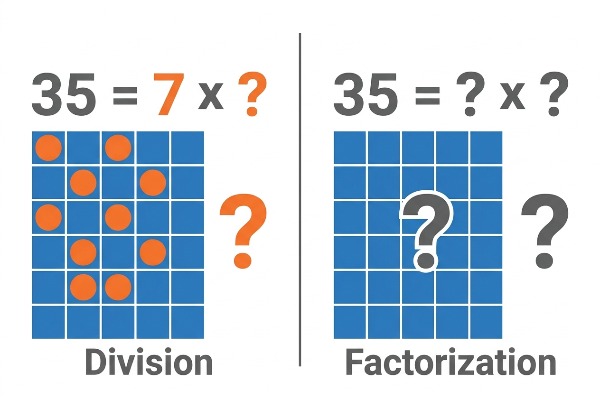
It's easy to confuse division with factorization, but there's a subtle yet important difference!
Division helps us find a missing factor when we already know one of them. For example, if we have:
Division tells us that the missing factor is 5, because:
So, we complete the equation as:
Factorization, on the other hand, is about finding both factors when neither is initially known. It's like solving
You're looking for pairs of numbers that multiply together to give 35. The factors are (1, 35), (5, 7), (7, 5), and (35, 1).
Think of it this way: division helps fill a gap in a multiplication problem, while factorization helps you discover all the possible building blocks of a number!
So, what's the core idea behind factorization? It's all about breaking down a number or an expression into its basic building blocks—its factors. If you have a number, let's call it and you can write it as a product of two other numbers, say ' and , then and '' are the factors of ''. We express this simply as:
This fundamental idea is what we'll apply to algebraic expressions, helping us simplify them and solve more complex problems!