Mount Meru - Pyramid of Numbers
Hey there, learners! Just a heads-up: this lesson takes a unique approach to some ideas. You'll find stories, examples, and even some terms that might be a little different from what you usually see in your textbooks or classroom. It's all part of exploring new perspectives and making learning fun!
Ancient Indian mathematicians were exploring numerical patterns. Let's embark on a journey to discover "Meru Prastāra" aka Mount Meru, which means "Mountain of Meru" in Sanskrit. Around the 2nd century BCE, the Indian mathematician and poet Pingala introduced the concept of Mount Meru in his work on Sanskrit poetry, focusing on its rhythms and sounds. He used it to understand patterns in poetry.
Later, in the 10th century CE, commentator Halayudha elaborated on Pingala's work. He described how to draw Meru Prastāra by starting with a "1" at the top. Each number below is the sum of the two numbers directly above it.
Imagine a pyramid of numbers. The edges always have "1"s. To find any other number, simply add the two numbers directly above it. For example, the "2" in the second row comes from . The "3"s in the third row come from and .
Meru Prastāra was not just a mathematical curiosity. It helped ancient Indian poets and composers understand rhythmic patterns and variations in poetic meters, revealing a deep connection between numbers and art.
Now that you know the method described by Halayudha, try drawing your own Meru Prastāra. See how many rows you can build! This will help you appreciate the beauty and history behind this amazing pattern.
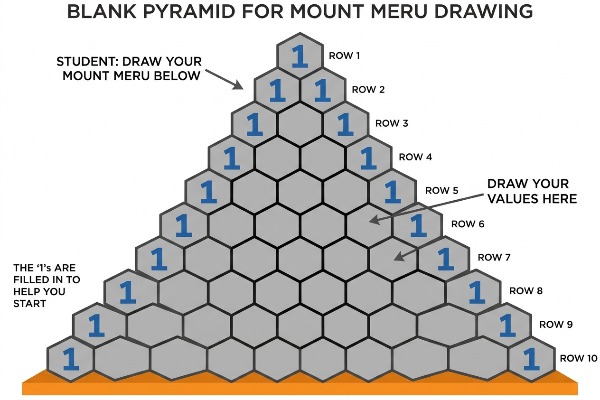
Draw your own Mount Meru (Pascal's traingle)
Let's build your very own Mount Meru! You'll see that the number '1' is already filled in for the first and last box of each row. This is a great starting point for our number pyramid.
Here's how you can fill in the rest of the boxes for all 10 rows:
- Start with the Second Row: Look at the '1's in the first row. The boxes in the second row that are not '1's should be filled by adding the two numbers directly above them. So, for the middle box in the second row, you'll add the two '1's from the first row ( ).
- Continue Down the Pyramid: For every subsequent row, follow the same simple rule: Each empty box's number is the sum of the two numbers in the row directly above it, just like we saw in Halayudha's explanation.
- Use the Pre-filled '1's: Remember, the '1's at the beginning and end of each row are already there for you. You only need to calculate the numbers in between.
- Complete All 10 Rows: Take your time and fill out each row carefully. You'll see amazing patterns emerge as you build Mount Meru down to its 10th row!
Using Mount Meru
Beyond drawing beautiful number patterns, ancient Indian scholars and poets found a powerful tool in Mount Meru. They used its structure to understand and create intricate poetic compositions, blending mathematics with the art of language.
Think about songs you know, like "Twinkle, twinkle, little star." If you carefully say each line, you'll notice it has seven syllables, often following a specific pattern of alternating short and quick (light) sounds with longer, held (heavy) sounds. For example, in "Twin-kle, twin-kle, lit-tle star," each line has 7 syllables, where the pattern of light and heavy syllables creates its unique rhythm.
This is where Mount Meru comes in! The numbers in Mount Meru actually help us count these combinations. For a 7-syllable sequence, like in "Twinkle, twinkle, little star," if we consider combinations of 4 heavy and 3 light syllables, the 7th row of Mount Meru will show us that there are 35 different ways to arrange these. The specific pattern used in "Twinkle, twinkle, little star" is just one of these 35 possible combinations! Ancient poets used Mount Meru to count and arrange these short and long sounds, creating specific rhythmic patterns called 'meters' for their poems.
Why were these rhythmic patterns so important? In ancient times, before books were common, people passed down vast amounts of knowledge, stories, and sacred texts by reciting them. A precise rhythm and rhyme scheme acted like a memory aid, making it much easier to remember long pieces of prose accurately.
To ensure knowledge was passed down accurately over many centuries, these rhythmic and melodic structures were followed very strictly. It was like a musical formula that helped prevent mistakes and kept the information pure, generation after generation.
Through Mount Meru, we see how mathematics isn't just about numbers; it's a fundamental tool that can enrich art, language, and culture. This interplay of logic and creativity shows the beautiful harmony between different fields of knowledge.